
Everything You Need to Know About Voice AI
Everything You Need to Know About Voice AI
Voice AI is transforming how businesses handle calls and customer interactions. From instant lead response to 24/7 customer service, AI-powered voice agents promise huge advantages.
Before you jump on the bandwagon, be warned you need to know that there are hidden pitfalls that could turn this dream technology into a nightmare for your business. In this guide, we’ll cover the must-know facts about Voice AI. The benefits, the dangers (yes, even big brands like Taco Bell have hit bumps in the road[1]), what to look for in a provider, and why a custom-tailored solution might be your smartest move.
By the end, you’ll not only be informed – you might also feel a healthy concern about doing Voice AI the right way, and eager to learn how to make it work safely and effectively for your business. Let’s dive in (and don’t miss the surprising stat about how fast you need to respond to new leads to win them over – it’s coming up soon).
What Exactly Is Voice AI?
Simply put, Voice AI refers to AI-driven systems that can engage in spoken conversations with people. These can range from smart assistants (think Alexa or Siri) to advanced AI voice agents that answer your business’s phone calls. Under the hood, a voice AI agent typically uses:
- Speech Recognition: to hear and transcribe what the caller says (using technologies often based on machine learning).
- Natural Language Understanding: to interpret the caller’s intent (usually powered by AI models like GPT).
- Decision Logic: to figure out how to respond or what action to take (e.g. access info, ask a follow-up question, route the call).
- Speech Synthesis: to talk back in a natural-sounding voice (often via tools like ElevenLabs or other text-to-speech engines).
In practice, when a customer calls, a voice AI system can answer, have a conversation to assist the customer or gather lead information, and even execute tasks like scheduling appointments or answering FAQs – all without a human on the line. It’s like having a tireless, ultra-fast receptionist who never sleeps and never gets flustered. No wonder Voice AI is exploding in popularity, with analysts projecting steep growth in this sector in the coming years[2]. (See the chart below for a glimpse at how fast this market is expanding.)
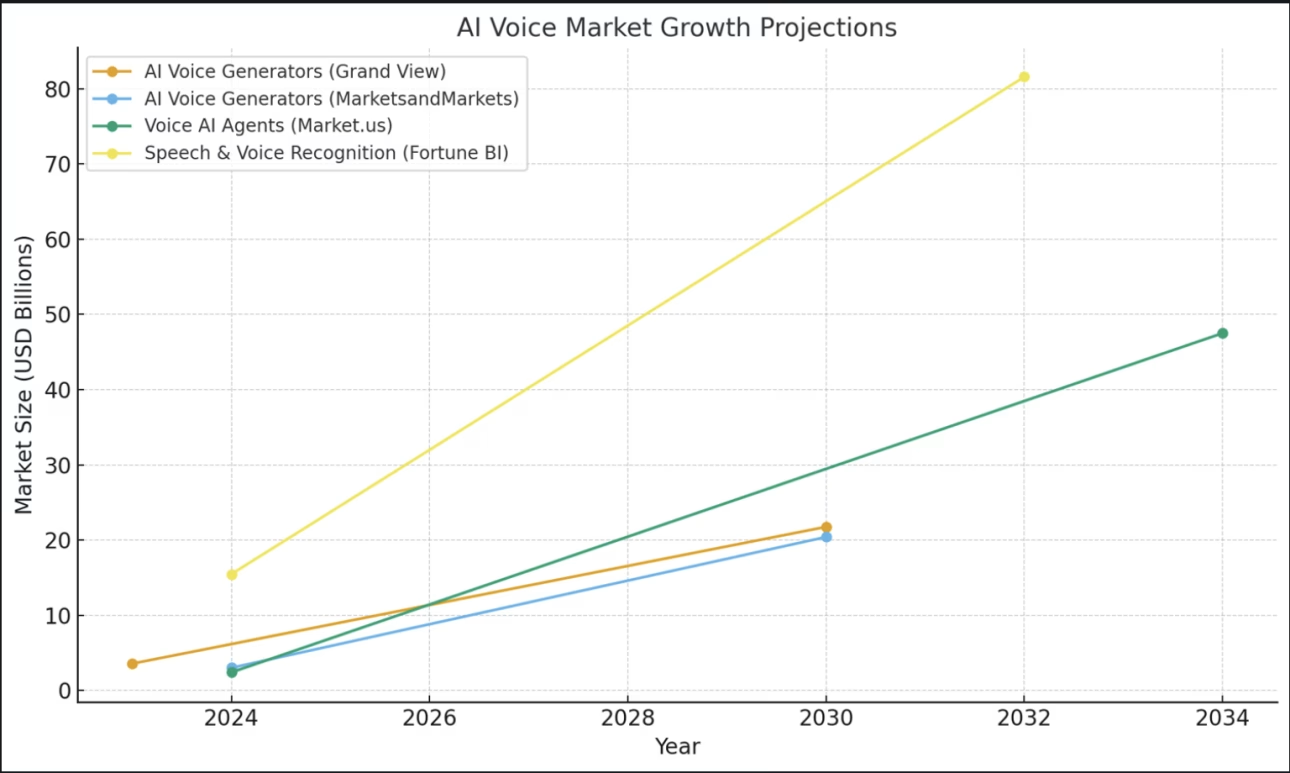
Voice AI market size is projected to grow exponentially in the coming decade[2]. The surge is driven by businesses seeking AI-driven voice agents to handle calls, with forecasts reaching tens of billions of dollars worldwide.
But as amazing as it sounds, Voice AI isn’t magic – it’s technology. And like any technology, its value depends on how you use it. To appreciate why so many businesses are investing in voice AI, let’s look at the biggest benefits. (After that, we’ll pull back the curtain on some scary truths and dangers most providers won’t tell you about. Stay tuned – you’ll want to hear that before making any decisions.)
Why Businesses Are Embracing Voice AI
Imagine never missing another customer call. Imagine every inquiry getting an instant answer, even if it’s 2 AM on a Sunday. That’s the promise of Voice AI, and it comes with tangible business benefits that drive adoption:
- ✅ 24/7 Availability – No More Missed Opportunities: A Voice AI agent can answer calls anytime, day or night. This is huge because missed calls often equal missed sales. Studies show businesses miss around 40% of inbound calls on average[3] – whether due to after-hours calls or overwhelmed staff. And here’s the kicker: 80% of callers sent to voicemail won’t even leave a message; they’ll just hang up and call a competitor[4]. Ouch. An always-on AI assistant ensures every caller is greeted and helped, so potential customers aren’t slipping through the cracks. In fact, a case study in real estate showed that implementing 24/7 AI agents increased lead capture by 30%, eliminating missed opportunities due to time zone differences[5]. Think about that – 30% more leads just by answering after hours!
- ✅ Lightning-Fast Lead Response: Speed to lead is critical. Responding to inquiries quickly can make or break the sale. How quick is quick? Try under five minutes – or even instantly. If that sounds extreme, consider this: 78% of customers buy from the first company that responds to them[6]. And one study found that contacting a lead within 5 minutes can make them 21 times more likely to qualify compared to waiting just 30 minutes[7]. That is not a typo – waiting a half hour instead of five minutes can absolutely tank your conversion chances. The reality is, every minute matters. A Voice AI can pick up and start the conversation immediately. No waiting, no voicemail – just an instant, helpful response. This dramatically boosts your chances of converting that prospect into a customer before they wander off to another option. (For instance, Harvard Business Review reported 5-minute responders enjoy 21× higher success in qualifying leads than those who delay[7], and another analysis noted conversion rates can be 100× higher vs. a 30-minute wait[8]!). In sales, being first is being king, and Voice AI makes sure you’re always first.
- ✅ Greater Engagement and Consistency: Unlike humans who might forget to mention a detail or have an “off” day, AI agents follow the script and process perfectly every time. They capture key details from callers consistently and can be programmed to ask the important qualifying questions every single time. This means better data on your leads and customers. It also means customers get a reliable experience – no more prospects falling off because someone forgot to follow up on a question. Plus, an AI can be trained to use your branding and tone consistently, giving a uniform professional impression. (No more worries that one receptionist might be chipper and another terse – the AI voice persona can be calibrated exactly to your brand’s style.)
- ✅ Cost Savings & Scalability: Hiring staff to man phones 24/7 or to handle sudden spikes in call volume is expensive (if not impossible). Voice AI lets you scale up call handling at a fraction of the cost of hiring. You don’t pay overtime, and the AI can handle many calls simultaneously if needed. One real estate firm, for example, deployed AI calling agents and cut their operational costs by over 55% while boosting lead conversion by 30%[9]. By automating repetitive call tasks, they reduced the need for a large call center team. Those savings drop straight to the bottom line. And your human team is freed to focus on high-value activities (closing deals, solving complex customer problems) while the AI does the grunt work like answering FAQs, scheduling, and data entry.
- ✅ Never Forget a Follow-Up: Voice AI can be integrated with other systems to not only handle the call, but also trigger automatic follow-ups. For instance, if a customer calls to ask about a service and the AI provides info, it can then send the caller a text or email with details, brochures, or a scheduling link. It can also nurture leads by calling them back or sending reminders if they showed interest but didn’t convert immediately. Humans have a hard time keeping track of every single lead over weeks, but an AI never forgets. This means more consistent nurturing of prospects over time, leading to higher conversion rates.
- ✅ Handle High Volume with Ease: Have a big promotion or a sudden influx of inquiries? A phone agent can only handle one call at a time – but an AI system can be replicated across as many lines as needed. No more busy signals. During peak times, you won’t be losing customers just because all lines were occupied. The AI can effectively “clone” itself to meet demand, ensuring every caller gets through. This is especially useful for marketing campaigns – you can confidently drive calls without fear of overwhelming your reception.
Those benefits explain why voice AI is catching on fast. It offers a potent mix of improved customer experience (fast answers, no holds) and improved business results (more leads captured, more consistency, lower costs). It sounds like a dream solution – and it can be. But, and this is a big but, adopting voice AI isn’t without risks. In fact, if done poorly, it could hurt your business more than help. Before you rush out to sign a contract with the first Voice AI vendor you find, let’s explore the darker side of this tech – the things many providers downplay or won’t tell you. These are the “psychological triggers” we hinted at – the fear and risk factors that you need to consider. Ready for some eye-openers?
The Hidden Dangers and Pitfalls of Voice AI
Like any emerging technology, Voice AI has its hazards. To make an informed decision, you need to be aware of these potential dangers – so you stay in control and avoid costly mistakes:
- ❗ Privacy and Security Risks: Your Voice AI will be handling customer conversations – which often include personal details, contact info, maybe even payment or account data. If the system isn’t properly secured, you could have a serious data breach on your hands. Shockingly, voice AI systems can be vulnerable to hacking, allowing attackers to gain unauthorized access to personal information or even misuse the system[10]. In one university experiment, researchers found ways to inject inaudible commands and hijack voice assistants[11]. And there have been real-world incidents: Amazon and Google have faced legal heat for how their voice AIs recorded and stored users’ voices without proper consent[12][13]. The lesson for a business setting? Make sure any voice AI solution has rock-solid security (encryption, secure data storage, authentication measures) and complies with privacy laws. Your customer trust is on the line. The last thing you want is headlines about how your company “leaked” call recordings or allowed customer data to be compromised. Any reputable provider should be able to explain how they safeguard your call data. If they can’t, run.
- ❗ Inaccurate or Inappropriate Responses: An untrained or poorly configured AI can go off-script – giving wrong answers or even inappropriate responses. This is not just theoretical. Even big brands have stumbled; for example, Taco Bell’s early foray into drive-thru voice AI delivered mixed results and had to be rethought because the AI sometimes misunderstood orders or context[1]. In your business, if the AI misunderstands a customer’s request and gives incorrect info (imagine an AI telling a client a property is available when it’s sold, or booking an appointment on a date that’s actually unavailable), you’ll have angry customers and fires to put out. Consistent accuracy is critical. Achieving that often requires careful training with domain-specific data and lots of testing. Don’t let any vendor convince you their AI is 100% perfect out-of-the-box. Demand to know how it handles edge cases, how it’s been trained for your industry’s vocabulary (does it know the difference between “lease” and “leasehold” in real estate? Or understand medical jargon if you’re in healthcare?). Also, consider how the AI deals with accents or speech differences – especially in a diverse market or in fields like disability support. If your callers include people with strong accents, or someone with a speech impairment, will the AI handle it? One case study in the disability support sector noted the biggest challenge was getting the AI to understand diverse accents and speech patterns with high accuracy – it’s not easy[14]. A mistake or a “Sorry, I didn’t get that” repeated too often can frustrate and alienate customers.
- ❗ Customer Experience Backlash: People crave quick service, but they also hate feeling like they’re talking to a robot if the experience is poor. An AI that sounds too robotic, responds with obvious scripted lines, or worse – fails to understand and gets stuck in a loop – will drive callers nuts. This can actually hurt your brand’s reputation. There’s a psychological trigger here: if someone calls your business and gets a clunky robot, they might think you’re too cheap to hire a real person or that you don’t care about personal touch. They might not say it to you, but they’ll feel it – and possibly walk away. It’s crucial that any voice AI feels natural and helpful, not like an answering machine from the 90s. Modern AI voices can sound very human-like (ElevenLabs, for instance, is known for remarkably lifelike voice synthesis[15]), so there’s no excuse for a monotone robot voice anymore. Still, even a good voice needs a well-designed conversation flow behind it. If the AI doesn’t gracefully handle when it gets confused (e.g. by looping in a human or at least apologizing and trying a different approach), you risk losing the caller’s trust. Always approach Voice AI from the caller’s perspective: would you enjoy the experience or get frustrated?
- ❗ Over-reliance and Downtime Risks: If you route all your calls to an AI, what happens if the system goes down or some part of the pipeline fails? Many voice AI solutions rely on multiple cloud services – telephony from one provider, AI from another, etc. An outage in any of these could mean calls go unanswered or drop. Do you have a failover plan? Also, if the AI can’t handle something and there’s no easy “press 0 for human” option, you could be locking customers out from getting help. Ensure any solution has a backup plan (like routing to voicemail or a human agent if the AI fails or if the customer asks for a human). Remember, technology should augment your team, not totally replace the safety net of human support.
- ❗ Data Ownership and Compliance: This one is subtle but important. When you use a Voice AI service, find out who owns the call data and recordings. Some providers might use your data to further train their models or, worse, they might not be compliant with regulations (like GDPR, HIPAA, or industry-specific rules) regarding storing voice data. If you’re in a field like healthcare or NDIS (disability services in Australia), privacy laws are strict – you can’t have call data floating around improperly. Make sure the solution lets you retain ownership of data and wipe it if needed. Also, check if they can run on a private cloud or on-premises if you have high security needs. A lack of transparency here is a red flag. The last thing you need is finding out that sensitive client conversations were used to “improve the AI” without consent. Reputable vendors will often offer clear data processing agreements. If they don’t volunteer this info, ask.
Whew, that’s a lot of potential danger, right? It might even make you hesitant about Voice AI altogether. That’s actually a good thing – healthy skepticism will ensure you choose a solution that truly works for you without nasty surprises. The takeaway is not to avoid Voice AI, but to implement it wisely. In the next sections, we’ll arm you with knowledge of how to spot the differences between the myriad Voice AI offerings out there, and what to look for when choosing one. Equally important, we’ll reveal a little industry secret: many “Voice AI” products aren’t as high-tech as they seem. In fact, you could be paying a premium for something that’s essentially cobbled together from the same basic tools everyone else has. Understanding this will help you cut through the marketing fluff and find a solution (or partner) that actually delivers unique value.
Ready to pull back the curtain? Let’s expose what’s really going on behind many Voice AI platforms – and how you can avoid being bamboozled.
The Surprising Truth Behind Many Voice AI Platforms
Here’s a dirty little secret in the Voice AI industry: a lot of providers are all using the same underlying tech. They just dress it up in different branding. To be blunt, many Voice AI “software” products are basically a combination of a phone service, a speech-to-text and text-to-speech engine, and some scripting – glued together with a no-code tool. It’s not that they’ve built some revolutionary AI from scratch; they’re orchestrating existing building blocks (which you could theoretically do too).
For example, a very common tech stack is: Twilio for phone calls, an AI voice like ElevenLabs for speech, and a workflow tool like n8n for logic[16]. Twilio handles dialing, ringing and audio streams; ElevenLabs provides the voice that speaks; and n8n (an open-source automation platform) acts as the “brain” that decides what to say next (often by calling an AI like GPT for understanding). If this sounds modular, it’s because it is. There are platforms like Retell AI and others that package this all so you don’t have to wire it up yourself[17]. But the key point: the fundamentals are not a mystery. In fact, developers and small teams have been building their own voice agents using these exact tools – there are even YouTube tutorials on how to do it in under an hour!
Why should you care? Because if a vendor is basically reselling you a prettied-up combination of common APIs, you need to ask: what am I really paying for? Is it their proprietary genius, or just the convenience of not having to DIY? Now, there’s nothing wrong with using best-in-class components – actually it’s smart. But the concern is when companies lack transparency about this. If they’re charging you exorbitantly while their back end is essentially a rented Twilio line and an ElevenLabs subscription, that might not sit right with you – especially if issues arise (e.g., “Why can’t it have a more emotional voice?” – well, because they’re limited by ElevenLabs’ current capabilities).
Another issue: many of these providers have the same voices since they use the same TTS engine. Ever notice multiple apps all offer a voice that sounds eerily like the same person? It’s a giveaway that they’re all tapping into the same source. So where’s the branding uniqueness for you? If your competitor uses the same platform, your AI receptionist might literally sound identical. That’s not great for differentiation.
Also, if everyone is using, say, GPT-4 for the AI brain, then the core smarts of many voice agents are pretty similar. The differentiator becomes how well they design the conversation flow and integrate with your systems – which is more a service than a product. We’re not saying these companies have no value – many add nice UIs, analytics dashboards, easier integrations, etc. But be aware that under the hood, it’s often off-the-shelf tech. AgentVoice, VAPI, Retell… these are known solutions enabling small teams to spin up voice agents quickly[17].
Why is this a danger or problem? Two reasons:
- Lack of Unique Customization: If a solution isn’t truly custom-built, it might not adapt well to your unique needs. You might be forced to fit into their template (because their system was made to be generic for many users). Truly unique requirements – say integrating with a weird legacy database, or handling an unusual conversation flow – could be “out of scope.” They might say it’s not supported because their workflow tool can’t do it easily. In contrast, if something is built specifically for you (even using those same building blocks but configured just for you), it can be as flexible as you want.
- Security/Control Issues: Relying on third-party components means your provider is reliant on them too. If Twilio has an outage, your calls fail. If ElevenLabs API changes, your provider scrambles to fix it. And importantly, your call data is flowing through multiple external services (Twilio, 11Labs, etc.). Do you know if those are secure and compliant? A provider who truly owns their stack might run the speech engine on their own servers or have more direct control. If they’re basically piggybacking on other platforms, there’s a chain of custody of data that you should understand. Are recordings stored on the TTS provider’s cloud? Is the call transcription passing through a third-party that might keep a copy? These are questions to ask.
The bottom line: Ask what’s under the hood. You don’t need all the technical nitty-gritty, but do ask a potential voice AI vendor: “What technologies power your solution? Did you develop your own speech engine or AI, or do you integrate existing services?” A trustworthy provider will be upfront. If they get cagey or throw a bunch of jargon without clarity, that’s a yellow flag. Either they don’t want you to know they’re mostly glueing others’ tech (for fear you’ll think it’s easy), or worst case, they don’t fully know what they’re using (if they white-label someone else’s service).
Knowledge is power here. Knowing that voice AI isn’t magic means you can cut through exaggerated claims. For example, if a vendor says, “Our AI is powered by a cutting-edge proprietary algorithm that understands humans like never before,” yet in fine print it’s using Google or OpenAI under the hood – you’d know they’re just marketing fluff. Instead, look for what value-add they bring: do they have an amazing conversation design team? Do they offer a library of pre-built industry dialogues? Do they ensure compliance in a special way? Those could be legit value adds worth paying for. But if it’s just hosting a standard voice agent that you could assemble with a decent developer, be mindful of overpaying.
Now, armed with an understanding of both the bright side and dark side of Voice AI, let’s get practical. How do you go about choosing the right voice AI solution or partner? What should you consider, especially as a business operator who wants results without headaches? In the next section, we break down the key questions and criteria you need to keep in mind when evaluating Voice AI for your business. This is essentially a checklist born from what we’ve learned so far. Let’s jump in.
Choosing a Voice AI Provider: Key Factors to Consider
Not all Voice AI solutions are created equal – as we’ve seen. To make sure you get the benefits without the regret, use the following checklist when evaluating providers (or deciding to build your own). These are the questions that savvy, “operator-to-operator” people focus on, beyond the sales hype:
- 📝 Use Case Fit and Industry Expertise: Does the provider understand your industry and use case? A voice AI that’s great for, say, restaurant ordering may not work for a law office without major tweaks. Look for experience or case studies in your field. If they have templates or examples (like “Real Estate lead bot” or “Dental clinic appointment AI”), that’s a good sign. At minimum, ensure they’re willing to learn your domain and perhaps include your team in training the AI on relevant terminology.
- 🛡️ Security & Compliance: We can’t stress this enough – ask how they handle data. Is voice data encrypted in transit and at rest? Who can access the call recordings or transcripts? Can they support compliance needs like GDPR’s right-to-erasure (e.g., delete my data on request)[18]? If you’re in a regulated industry (finance, healthcare, NDIS, etc.), do they have compliance measures in place (like HIPAA compliance for health info, or data residency options if data must stay in-country)? A strong provider will often volunteer this info via security whitepapers or certifications. If they stare blankly when you bring up data security, move on.
- 🤖 Voice Quality and Customization: What voice options do you get? Are the voices natural-sounding? Can you choose different personas or even create a custom voice? Branding is important – for example, you might want the AI to have a friendly Australian accent if your brand is local and casual, or a formal tone for a high-end professional image. Some providers let you train a custom voice model (possibly using recordings of a voice talent or your own voice) for a unique sound. If that’s important to you, check if they support it. At the very least, ensure the default voices don’t sound robotic. Ask to hear samples. Also consider languages – if you serve multi-lingual customers, does the AI handle those languages fluently? (The real estate case study earlier highlighted multi-language support boosting engagement by 40%[19] – huge if you have diverse clientele).
- 🔄 Integration Capabilities: A voice AI isn’t an island. It should connect to your world – CRM, calendar, database, ticketing system, etc. Does the solution offer easy integrations (APIs, webhooks) to pull/push data? For example, if a caller is asking about their order status, can the AI fetch that from your system in real-time? If someone wants to book an appointment, will it actually create one in your calendar? The best voice AI solutions act as an extension of your business processes. Avoid ones that operate in a silo (e.g., it answers FAQs but can’t log a lead in your CRM – that creates more work). Also ask: can it trigger follow-up actions like sending an email or notifying a salesperson when a hot lead comes in? Your goal is a seamless workflow where the AI and your human team hand off to each other smoothly.
- 📊 Reporting and Transparency: Insight is important. What kind of analytics or dashboard is provided? You’ll want to see call volumes, outcomes (e.g., how many calls were fully handled by AI vs. handed to humans), drop-off rates, and maybe even sentiment or common request types. Also, can you listen to recordings or review transcripts of AI-handled calls? (This is very useful for monitoring quality and tweaking scripts). A good provider will give you the tools to measure the AI’s performance and your ROI. If they just deploy it and say “trust us, it’s working,” that’s not enough. You should see the impact – e.g., “this month the AI answered 200 calls, qualified 50 leads, booked 30 appointments, here’s the conversion funnel, etc.”
- 🛠️ Ease of Tuning and Control: After deployment, how easy is it to tweak the AI’s behavior? Can you update the script or add a new FAQ answer without calling the vendor’s engineering team? Some solutions have a user-friendly interface to adjust questions, change wording, or update knowledge base info. This is valuable because your business content changes – you want to be able to update the AI as you go (e.g., add a new promotion detail, or change how it answers a pricing question). If every little change requires a costly change request, you’ll feel stuck. Look for a solution that empowers you (or at least has a quick turnaround from the vendor for updates).
- 🤝 Fallback to Human & Escalation: As mentioned earlier, no AI can handle 100% of situations. What happens when the AI is stumped or the caller insists on a human? The system should have a polite way to either transfer the call to a human (during business hours perhaps) or at least take a message/send an alert for a human to follow up ASAP. Some advanced systems can even conference in a human agent on the fly if needed. The key is you don’t want the call to just fail. Even if 3% of calls need human handling, those 3% could be your VIP clients or very high-value deals – so plan for that. Make sure the provider supports graceful escalation paths.
- 💰 Pricing Model: Understand how you’ll be charged. Is it by the minute of AI talk time? By number of calls? A flat monthly fee for X usage? Also factor in costs of the underlying services if known (for instance, if you were DIY-ing, Twilio charges per minute, etc., so compare if the provider’s markup seems fair given the value they add). Beware of “per call” pricing that doesn’t cap – if your call volume spikes, you don’t want a budget shock. Also ask if there’s a pilot or trial period – best to test in a low-risk way.
- 📈 Proven Results: Lastly, ask for results they’ve achieved for clients. Any data or case studies? For example, did they help another business cut hold times by 90% or increase appointment bookings by 2X? Hard numbers will not only validate their effectiveness but also give you confidence that they understand delivering ROI. We saw earlier a real estate firm got 30% more lead conversions with AI[9] – ask for stories like that in your context. If they can’t share any success stories, that’s worrisome (unless you’re truly an early adopter of a new solution).
Using this checklist, you’ll quickly separate the contenders from the pretenders. You’ll find that some providers shine in certain aspects but not others. Prioritize what matters most for your business. For many, security and lead conversion boost might be #1; for others, it might be integration and user experience.
Now, there’s one more thing to consider: should you buy an off-the-shelf solution at all, or have one built specifically for your business? This is where we talk about custom-built Voice AI versus pre-made platforms. And yes, in full disclosure, this is where we explain why our approach – building bespoke voice AI solutions for companies – often yields the best results. We’ve hinted at it throughout, but let’s address it head on so you can make the best decision for yourself.
One Size Does Not Fit All: The Case for a Custom Voice AI (and Examples by Industry)
Every business is unique – your processes, your customer base, your brand voice, all of it. So why settle for a cookie-cutter voice AI? We firmly believe (backed by experience) that the highest ROI comes from Voice AI systems custom-built for your specific business, tailored to your branding and tuned to your exact needs. Off-the-shelf platforms can work, but they often require your business to do the adapting. A custom solution, by contrast, adapts to you.
Let’s illustrate this with a few industries where we’ve implemented voice AI, to show just how nuanced the differences can be and why that matters:
Real Estate – Capturing and Nurturing Property Leads
The scenario: Real estate agencies live and die by lead responsiveness. A potential buyer calls about a listing – if no one answers, they’re likely onto the next agent. Also, agents are often out on inspections or meetings, not sitting by the phone. We built a Voice AI system for a real estate firm that acts as a virtual assistant for all inbound inquiries.
What it does: It answers every call, greets the caller with the agency’s name and a warm tone, and can handle common tasks like: providing details on property listings (price, number of bedrooms, etc.), scheduling an appointment or open house visit, or taking down the caller’s requirements (budget, preferred suburbs) if they’re a buyer. It even answers basic questions like “What’s the address of your office?” or “How do I apply for a rental?” from a knowledge base.
The nuance: Real estate calls can be high-value, so the AI was given a “concierge” personality – very polite, enthusiastic but not overbearing. We integrated it with the agency’s CRM and calendar. When a lead calls about 123 Maple Street, the AI pulls that listing’s info from the database to answer specifics (“Yes, 123 Maple Street is still available. It’s a 4-bed, 2-bath with a pool. Would you like to schedule a viewing?”). If the caller wants a viewing, it checks the agent’s calendar availability and books it right then and there. Importantly, it captures the caller’s contact info and what they were interested in, then instantly logs a lead in the CRM and even texts the relevant agent saying “New lead interested in 123 Maple, scheduled for Saturday 10am.” The human agent goes into that meeting fully informed.
Results: The outcomes were fantastic – the agency never misses a call now. They even capture international leads overnight (because the AI handles after-hours calls). Lead response delays dropped to near zero, and they saw a significant uptick in conversion. In fact, as noted earlier, having 24/7 AI coverage increased lead capture by ~30% for them[20]. They also cut down on admin time for agents by automating scheduling and FAQs, reducing workload by 70% on those repetitive tasks[21]. And here’s a kicker: we made the AI multilingual. In that area, there were many non-English-speaking investors; the AI could seamlessly switch languages (it supported 13 languages) to engage those callers, resulting in a notable increase (25%) in new client acquisitions from non-English markets[22][23]. Try getting that level of customization from a generic platform!
Why custom mattered: We could integrate deeply with their systems and craft dialogues specific to real estate. For example, if someone said “I saw your sign at Maple Street, can you tell me the price?”, the AI was ready for that context. A one-size bot might not know what Maple Street is without being explicitly programmed. Our solution was theirs – it knew their inventory, their team contacts for different areas, etc. Branding-wise, we even cloned a voice that sounded like a friendly yet professional agent common in their region – making the experience cohesive.
NDIS and Healthcare – Empathy and Compliance in Support Calls
The scenario: Businesses providing services under NDIS (National Disability Insurance Scheme) or generally healthcare support face unique challenges. Calls might be from people with disabilities or their carers, asking about services, scheduling appointments, or seeking assistance. There’s often sensitive information involved, and the callers may have specific communication needs. Also, there are privacy laws governing health/disability info. We built a voice AI system for an NDIS service provider to help handle routine calls and improve client outreach.
What it does: This AI assistant is extremely patient and empathetic in tone. It answers basic questions about the services offered (“Do you provide in-home occupational therapy in <suburb>?” – it can check and answer yes/no), explains how the NDIS funding process works for new inquiries, and can schedule appointments for assessments. It also performs outbound reminder calls – for instance, reminding clients of tomorrow’s session, or checking in on waitlisted clients to update them on slot availability. Importantly, if an existing client calls and the AI detects stress or urgency (say they mention a crisis or something the AI isn’t equipped for), it flags and routes the call to a human on duty immediately. We built in a kind of sentiment analysis and certain keyword triggers (“help”, “emergency”, “upset”) that prompt an escalation, because human care is vital in sensitive situations.
The nuance: Communication here is not rapid-fire like sales; it’s gentle and clear. The AI speaks a bit slower, uses reassuring phrases (“I’m here to help you with that.”). It also had to handle a range of speech patterns from users – we trained it on diverse Australian accents and even some speech impairment examples so it wouldn’t trip up as easily. This was crucial: in our development we found that standard speech recognition struggled with certain speech impairments. We adjusted the system and also allowed it to intelligently ask verification questions if unsure (e.g., “I want to make sure I got that right – you’re asking about mobility support, correct?”) rather than blurt a wrong answer.
Compliance was another big factor: all call data stays in Australia on a secure server; recordings are encrypted and only accessible to authorized staff. We built it to not record certain sensitive data at all (if someone starts giving a medical ID number, the AI recognizes that pattern and does not store that segment). These are the kinds of fine-grained controls a custom solution can implement.
Results: The NDIS provider was able to extend support hours without burning out their staff – clients could call anytime and get answers or leave messages through the AI. Routine queries (which were a large volume) got handled instantly, freeing the human support workers to focus on complex cases. Clients reported high satisfaction, often not realizing they weren’t talking to a human – they just appreciated someone was always there to take their call and assist. By nurturing clients with gentle outbound check-ins (something the staff often didn’t have time to do systematically), they actually improved client engagement and reduced no-shows (since reminders were always sent). The organization could take on more clients without hiring a ton of administrative staff. And importantly, there were zero compliance issues, because we engineered the solution with data protection from day one – giving the managers peace of mind.
Why custom mattered: This level of empathy and compliance tailoring is not something you get off-the-shelf. The AI essentially became part of their care team, trained in their specific procedures and values. Generic voice bots might sound too cold or not handle the delicate nature of such calls. Our solution reflected the caring brand ethos of the company – which is critical in health and support services. It’s a great example of how voice AI isn’t just about efficiency; it can enhance the quality of service when done right.
Trade Services (Tradies) – Never Miss a Job (24/7 Receptionist)
The scenario: Think plumbers, electricians, contractors – “tradies” who are often one-person or small team businesses. These folks are frequently out on jobs, up on a roof, under a sink – definitely not sitting by a phone. Yet, new customers call at all hours with job requests. Every missed call could be a lost job, and in trades, people often call until someone picks up because they need help now. We developed voice AI “receptionists” for a few trade businesses (an electrician and a plumbing/HVAC company) to handle inbound calls.
What it does: The AI answers promptly with a friendly greeting like “Thank you for calling Joe’s Plumbing! How can we help you today?” It is capable of handling a few things right off the bat: if it’s an emergency (“my water heater burst and my house is flooding!”), the AI recognizes urgency and immediately gathers the address and details, then triggers an urgent alert to the on-call technician’s phone (via text and an automated call whispering the emergency details). It will say “Hang tight, we’re connecting you to our technician now,” and attempts a warm transfer if possible. If it’s a non-urgent inquiry (“I’d like to get a quote for a bathroom renovation”), the AI can schedule a callback or book an appointment for an estimate visit on a calendar. It asks for details of the job, perhaps using a guided series of questions (“Can you describe the issue or the work you need? Approximately how old is the property’s plumbing?” etc. – these were customized with the business owner to qualify leads). It can also provide info like service areas, business hours, and basic pricing info for common jobs, pulling from a small knowledge base.
The nuance: Trades businesses thrive on personal reputation, so we made the AI mirror the owner’s personable style. For one electrician, we even used the owner’s own voice (cloned with permission) for the AI, so customers literally thought they were talking to “Joe” himself even when he was busy – talk about branding! The script included a bit of personal touch (“Sorry to hear about that leak – we know how stressful that can be, but we’re here to get it sorted for you.”). That kind of empathy in wording was important to the client.
We also had to handle the scenario of fielding multiple calls at once. If three people call the plumber during a morning when a pipe burst (happens often when pipes freeze, etc.), the AI can juggle them – something a single receptionist couldn’t do. It politely manages each and assures them help is on the way or schedules a time.
Results: These trade businesses saw immediate impact. The electrician, who used to miss ~30% of calls while on jobs, now effectively misses 0 – every call is answered. He told us a lot of new customers actually complimented “his receptionist” without realizing it was AI, saying they appreciated someone picking up promptly. For urgent calls, the response time improved dramatically – even if the AI couldn’t solve it, the fact that it answered and initiated the dispatch process made customers feel taken care of. This led to higher booking conversion; people didn’t go to the next Google result to call another tradie, because they already got booked in or knew someone was coming. The plumbing/HVAC company saw their bookings from after-hours calls go way up – previously, calls after 6pm went to voicemail and often those folks called someone else. Now the AI handles those, books the next available slot or at least secures their details for a morning follow-up. The owner estimated a significant increase in monthly revenue simply by capturing jobs that used to be lost to missed calls. Plus, they didn’t need to pay for a full-time receptionist or answering service – the AI paid for itself in a couple of months.
Why custom mattered: Each trade business has its own typical calls and way of handling. We tailored the question flow to what each owner wanted. For instance, the electrician wanted the AI to always ask “Is anyone in immediate danger (like a fire or exposed live wire)?” for safety – if yes, it actually instructed the caller to hang up and call emergency services before continuing with scheduling. That’s a liability and safety step a generic bot wouldn’t have. The plumber’s AI had a knowledge base of common issues (e.g., if someone said “tankless water heater not working”, it could provide a quick tip like checking the reset switch while they wait for the tech – small value-adds that show expertise). Those personal touches and specific know-how make the difference between a meh customer interaction and a “wow, they really helped me” interaction.
These examples highlight a common theme: the best Voice AI is deeply tailored to the business context. The differences in approach between industries are significant – and a one-size-fits-all solution would likely be mediocre in all of them. By building custom, we ensured each AI agent was an expert in its domain, with the right personality, knowledge, and integration.
Now, you might be thinking: custom sounds great, but isn’t it expensive or time-consuming? It can be more investment up front than signing up for a generic SaaS product, yes. However, the ROI often far outstrips a generic solution because it actually moves the needle on what matters (be it lead conversion, customer satisfaction, or operational efficiency). Plus, when built well, it’s your asset – it can evolve as your business evolves, without you being at the mercy of a vendor’s feature roadmap.
Since we have experience doing this, we also have frameworks and reusable components that make custom development faster and more cost-effective than you might think. Essentially, we use those same “building blocks” – the Twilios and ElevenLabs of the world – but we craft the blueprint uniquely for you, and crucially, we handle all the heavy lifting (and ongoing maintenance) so you don’t have to worry about the tech details. You get the best of both: state-of-the-art AI technology and bespoke design for your business.
Before we wrap up, let’s recap the key things you should know and then talk about how you can get started on a safe, effective Voice AI journey – perhaps even with our help, if you feel we’re a good fit.
Voice AI – The Future is Calling (Don’t Miss It, But Do It Right)
Voice AI is no longer sci-fi; it’s here now, actively helping businesses grow and serve customers better. We’ve covered a lot of ground – from skyrocketing conversion stats to cautionary tales of security and bad bots. By now, you should be both excited about the potential and appropriately aware of the pitfalls. That’s exactly where you want to be: excited but informed.
To summarize everything you need to know about Voice AI:
- It can dramatically improve your lead capture and customer service – with instant responses, 24/7 availability, and consistent follow-through. Remember, speed wins. Being the first to respond (even if it’s your AI) means you capture business that others lose. We saw stats like 78% of buyers go with the first responder, and conversion rates jump up to 21x with 5-minute response times[7]. Those are game-changing numbers.
- Missed calls and slow follow-ups are silent killers of business – and Voice AI is one of the most effective antidotes. Instead of losing an estimated 40% of calls that many businesses miss[3] (and knowing 4 out of 5 of those callers won’t try again[4]), you can stop the bleeding with an always-on AI assistant. No more leaking leads due to lunch breaks, after-hours, or busy lines. Every call becomes an opportunity captured or at least acknowledged.
- Security, privacy, and quality must be front and center – a good Voice AI solution will protect your data and brand. We discussed how improperly handled voice AI can lead to hacks or privacy violations (like voice data being mishandled) and how it can sour customer trust if done poorly[24]. The right approach uses encryption, compliance measures, and careful design to mitigate these risks. Don’t compromise here; insist on high standards so you can confidently deploy the AI as part of your operations.
- Many Voice AI products use the same underpinnings – know what you’re buying. It’s perfectly fine if a solution uses known AI engines or telephony APIs (that’s smart development), but ensure you’re paying for true value-add, not just a shiny wrapper on common tech. Transparency from providers was a key point – the more open they are about their stack and how they address your needs, the better.
- Customize for success – whenever possible, tailor the Voice AI to your business (or work with someone who can). The nuance in Real Estate vs. Healthcare vs. Home Services we explored demonstrates that detail matters. That’s how you get that extra 30% conversion, or that 60% productivity boost[9] – by tuning the AI to excel in your environment. A generic bot might only deliver a fraction of those results. If you have the resources, a custom solution built by experts (hi, that’s us 🙋♂️) will likely pay for itself many times over.
- Psychologically, Voice AI can trigger both positive and negative responses – use that to your advantage. We wove in some psychological triggers throughout this guide: the fear of missing out on leads, the anxiety about security breaches, the relief of solving problems quickly, the trust built by a friendly voice, etc. When implementing your AI, think about the customer’s emotions. Address their fears (“Don’t worry, help is on the way” for an emergency; or “Your info is safe with us” for privacy concerns) and hit their delight triggers (“Great news – I found an appointment slot that works for you!”). A well-designed voice AI doesn’t just transact, it engages emotionally at the right level. That’s how you make an AI interaction not just tolerable, but actually pleasant or reassuring for customers.
In closing, the world of Voice AI is full of opportunity. It’s like having a superpower for your business – but only if wielded with care. Implemented thoughtlessly, it could backfire. Implemented wisely, it can elevate your business to new heights, capturing revenue and impressing customers around the clock.
Why let us build it for you? Because we’ve been there and done that across industries. We know how to avoid the landmines and seize the wins. Whether it’s a sophisticated, branded AI voice that becomes the recognizable “voice” of your company, or a conversion-optimized lead qualifier that fills your pipeline while you sleep, we can create it. We pride ourselves on building voice AI systems that truly feel like a part of your team, not a clunky add-on. From ensuring top-notch security to crafting psychologically savvy dialogue, we handle the heavy lifting. You get a turnkey solution that is uniquely yours – configured, tested, and refined to deliver results (more bookings, faster responses, happier customers – and ultimately, more revenue).
The data speaks for itself: companies are already seeing cost reductions of 50%+ and conversion boosts of 30%+ by leveraging custom AI agents[9]. The technology is ready. The question is, are you going to let those benefits accrue to your competitors, or take the step to secure them for yourself?
If you’re curious or concerned (or a bit of both) about Voice AI after reading this, we invite you to reach out. We’d love to discuss how voice AI could specifically work for your business, address any concerns, and if it’s the right fit, build you a solution that makes you say “How did we ever live without this?”. The future is calling – quite literally – and with the right Voice AI, you’ll be the first to answer, every time.
Ready to explore having your very own branded Voice AI? Let’s chat. The only thing you stand to lose are those missed calls and missed opportunities – and haven’t they taken enough already? 😉
[1] [2] [14] [17] AI voice in 2025: Mapping a $45 billion market shift – AgentVoice
[3] How Much Does a Missed Call Cost You? You could be losing thousands of dollars.
[4] 80% of Callers Won’t Leave Voicemail: Here’s the Fix
[5] [9] [19] [20] [21] [22] [23] Voice AI Agents used by Real Estate Firm | Case Study – Supafunnel
https://supafunnel.com/voice-ai-case-studies/voice-ai-for-real-estate
[6] [7] [8] How Faster Lead Response Times Can Skyrocket Conversions
[10] [11] [12] [13] [18] [24] The Rising Privacy and Security Risks of Voice AI – Impala Intech
[15] ElevenLabs and the risks of voice-generating AI | TechTarget
[16] Automated Phone Receptionist for Scheduling with Twilio, ElevenLabs & Claude AI | n8n workflow template
What Exactly Is Voice AI?
Simply put, Voice AI refers to AI-driven systems that can engage in spoken conversations with people.
These can range from smart assistants (think Alexa or Siri) to advanced AI voice agents that answer your business’s phone calls.
Under the hood, a voice AI agent typically uses the below.

Speech Synthesis
Used to talk back in a natural-sounding voice (often via tools like ElevenLabs or other text-to-speech engines).

Speech Recognition
Used to hear and transcribe what the caller says (using technologies often based on machine learning).

Natural Language Understanding
Used to interpret the caller’s intent (usually powered by AI models like GPT).

Decision Logic
Used to figure out how to respond or what action to take (e.g. access info, ask a follow-up question, route the call).
In practice, when a customer calls, a voice AI system can answer, have a conversation to assist the customer or gather lead information, and even execute tasks like scheduling appointments or answering FAQs – all without a human on the line.
It’s like having a tireless, ultra-fast receptionist who never sleeps and never gets flustered.
No wonder Voice AI is exploding in popularity, with analysts projecting steep growth in this sector in the coming years [2].
(See the chart below for a glimpse at how fast this market is expanding.)
Voice AI market size is projected to grow exponentially in the coming decade[2].
The surge is driven by businesses seeking AI-driven voice agents to handle calls, with forecasts reaching tens of billions of dollars worldwide.
But as amazing as it sounds, Voice AI isn’t magic – it’s technology.
And like any technology, its value depends on how you use it.
To appreciate why so many businesses are investing in voice AI, let’s look at the biggest benefits.
(After that, we’ll pull back the curtain on some scary truths and dangers most providers won’t tell you about. Stay tuned – you’ll want to hear that before making any decisions.)